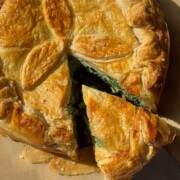
Torta Pasqualina
This torta pasqualina is the perfect savoury Easter recipe. Imagine a buttery, flaky puff pastry pie with a creamy, cheesy spinach and ricotta filling (and a hidden egg surprise).
Servings: 6 servings
Ingredients
- 500 g fresh baby spinach
- Olive oil
- 1 large garlic clove crushed
- 500 g full-fat ricotta
- 60 g Pecorino grated
- 6 large eggs
- ¼ tsp ground nutmeg
- Salt and freshly ground black pepper to taste
- Plain flour for dusting
- 2 x 25 cm square sheets ready made puff pastry about 330 g
To glaze:
- 1 large egg beaten
- Sea salt for sprinkling
Instructions
- Preheat the oven to 200C/180C Fan. Grease a 20 cm (8-inch) springform tin with olive oil or melted butter and set aside.
- Rinse the baby spinach thoroughly in a colander and remove any large stems. Set aside.
- Heat a drizzle of olive oil in a large non-stick frying pan set over a medium heat. Add the garlic and cook for about 30 seconds, stirring to make sure it doesn’t catch and burn, until fragrant. Add the spinach and cook for 2-3 minutes, stirring occasionally, until wilted - you may need to gradually add the spinach in batches, it depends on the size of your pan. I often find it is a bit of an awkward juggling act at first, but spinach famously wilts down as the water evaporates so it won’t be an issue for long.
- Once the spinach has wilted, spoon into a bowl and leave to cool completely. If you are in a rush, you can pop it in the freezer to chill down rapidly.
- Once the spinach has cooled, squeeze out any excess moisture -I normally do this with my hands but you can push it through a sieve or wrap in a clean kitchen towel and squeeze out the excess water. Don’t be tempted to skip this step - if your spinach has too much water, you will end up with a soggy torta pasqualina which isn’t what we want!
- Next, either blitz the spinach in a blender or finely chop with a sharp knife. Then pop into a large bowl and add the ricotta and pecorino, followed by 2 of the eggs. Mix well until combined, then add the nutmeg and season with salt and freshly ground black pepper.
- Lightly dust a work surface with flour and lay the pastry out on top. Using the greased springform tin as a template, cut out a large 20 cm (8-inch) circle - this will be the torta pasqualina lid.
- Use the second sheet of pastry to line the base of the tin, letting the sides overhang. Trim off a little of the excess pastry, using the offcuts to fill in any gaps - however, bear in mind you do need a fair bit of overhang to seal over the lid of the pie (have a look at the step-by-step images which explain in more detail).
- Spoon in the spinach and ricotta filling and spread in a smooth and even layer. Then, using a tablespoon, make 4 little wells equally spaced apart.
- Carefully crack an egg into each indentation, being cautious not to break the yolk. Add a tiny sprinkle of salt to each egg.
- Gently place the pastry circle ‘lid’ on top - take care not to break the yolks. Fold the sides over onto the top and press the edges together to seal. Brush the top of the pastry with a little beaten egg and sprinkle with a pinch of flaky sea salt.
- Use a sharp knife to gently pierce holes in the lid to let the steam out (be careful, you don’t want to plunge in too deep and break a yolk).
- Bake for about 45-50 minutes - or until the pastry is golden brown and puffed up and the filling is firm (obviously you wont know this until you cut into it, but the eggs should be set firm, like a hard boiled egg, so whilst at 35 minutes the pastry looks good, the eggs will be a bit soft).
- Remove from the oven and leave to cool for at least 30 minutes before removing from the tin.
- Slide onto a plate, cut into slices and serve warm or at room temperature.
Notes
Scroll up for a step by step guide on how to make torta pasqualina.
To store: the torta pasqualina can be made ahead, left to cool completely, then covered and chilled for up to 3 days.
To reheat: it is best not to reheat this torta pasqualina. Instead, enjoy any leftovers at room temperature or cold (in fact, it is traditionally served cold in Italy).
To freeze: it is best not to freeze this torta pasqualina due the spinach and eggs.
Make ahead: If you want to make the components separately, the spinach ricotta mix can sit in an airtight container in the fridge for 4 days. Then, when ready, you can fill the pastry case with it, crack in the eggs, cover with pastry lid and bake.
Make it vegetarian: this torta pasqualina uses Pecorino which has animal rennet so isn’t suitable for vegetarians. To make it vegetarian friendly, use a vegetarian strong Italian-style hard cheese instead. Alternatively, a strong mature Cheddar or something like Old Winchester works well.
Piercing the pastry: don’t be tempted to skip adding the slits to the pastry. These allow the steam to escape which helps ensure event baking and prevents the filling from bursting out.