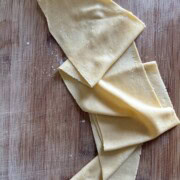
How To Make Easy Pasta Dough
This easy pasta dough recipe will provide you with the basic dough needed to make pasta from scratch. It has very few ingredients but just requires some kneading and some patience.
Servings: 4 servings
Ingredients
- 400 g ‘00’ flour plus extra for dusting
- 4 eggs
- Semolina flour to dust
Instructions
- Tip your pasta flour onto a clean surface and use the base of a mixing bowl to make a well in the centre. Crack in the eggs, then use a fork to break them up so the yolks and white are well combined. Begin to let in a little flour at a time, whisking to incorporate and being careful the egg doesn’t spill over the edge! Once you have a thick egg mix, use a bench scraper or your hands to bring in the rest of the flour until the mixture comes together in a shaggy dough.
- Knead the dough for around 10 minutes until all the flour is well incorporated and you have a smooth, tight ball. If your dough ever starts to feel dry, wet the tips of your fingers under the tap and continue to knead. Wrap the dough in cling film, then set aside to rest for 30 minutes at room temperature.
- Cut the dough into quarters, covering any with clingfilm that you aren’t working with to prevent it drying out. Working one piece at a time, flatten the dough on a lightly floured surface into a rectangle shape and pass it through the widest setting of your pasta machine. Fold both ends in to meet in the middle so you have a rectangle shape again, then pass back through the machine.
- Repeat this process a further 2 or 3 times, until your dough feels really smooth. Now, pass the sheet through the second-widest setting once, dusting it with a little flour if ever it feels sticky. Repeat this until you reach the second or third-narrowest setting - how thin you roll it depends on how you will cut or shape the pasta, a filled pasta requires a thinner dough.
- Transfer the rolled out sheet to a tray dusted with flour - use semolina if you have it as the dough won’t absorb this. Keep the pasta covered so it doesn’t dry out. Repeat with the remaining dough, then cut or shape the pasta as desired.
Notes
Scroll up for a visual step by step guide on how to make pasta dough.
To store: the dough needs to rest for 30 minutes before shaping. Don't let it rest for too long, no longer than an hour. You could roll the pasta, shape it and then once shaped, it is best cooked within 24 hours (keep in a sealed container in the fridge if shaping more than 1 hour before cooking).
To freeze: you can freeze shaped pasta dough. I would freeze it shaped over freezing dough. To freeze shaped pasta, open freeze on a tray for 20 minutes, then transfer to a sealed container or freezer bag for up to 3 months. Cook straight from frozen.
Make ahead: The dough wants to be used quickly. It shouldn’t rest for longer than 1 hour ideally. You could make it, wrap it in clingfilm and pop in fridge but it will be harder to work with as time goes on. It should be room temperature when rolling. You could roll the pasta, shape it and then once shaped, it is best cooked within 24 hours (keep in a sealed container in the fridge if shaping more than 1 hour before cooking). However, it freezes really well for up to 3 months (see notes for guidance). Plus, you can add straight to boiling water - no need to defrost.